Monday, July 6, 2015

Shortfin Mako Sharks


The Shortfin Mako Shark
           Isurus oxyrinchus                                                        

The shortfin mako is the worlds fastest shark, clocked at speeds of over 30 mph! They're a powerful species that are known to breach when hunting and when caught by fishermen.


Identification:
Shortfin makos are sleek sharks with very powerful tails. Their dorsal side is a bright metallic blue or purple, with silvery sides that fade to white on the ventral side. They have pointed snout with a U-shaped mouth and dark black eyes.
Mako sharks have long gill slits
The mako shark has strong and large keels on the caudal peduncle that allow them to swim at great speeds. Their caudal fins are the same size on the top and bottom, which allows them to speed through the water.


Classification:
Kingdom : Animalia
Phylum : Chordata
Subphylum : Vertebrata
Class : Chondrichthyes
Subclass :  Elasmobranchii
Superorder : Selachimorpha
Order : Lamniformes
Family : Lamnidae
Genus : Isurus
Species : oxyrinchus


Similar Species and Other Family Members:
There is another species of mako shark, the Longfin Mako Shark (Isurus paucus). The longfin mako is similar in appearance to the shortfin mako, only it has longer pectoral fins and larger eyes.
Isurus paucus


Reproduction:
Mako sharks are viviparous, meaning they give livebirth like humans do. A typical litter of mako shark pups is about 10-18 pups, but litters can range from 4-25 pups. Mako sharks exhibit oophagy, which is where the developing shark pups eat the unfertilized eggs in the womb.


Size:
Male shortfin makos mature at around 195 cm (6.3 ft), while females mature at around 270 cm (8.8 ft). The largest shortfin makos can reach up to 400 cm (approx. 13 ft)


Diet: 
Mako sharks eat mainly fish such as bluefish and swordfish. They will also eat other open water sharks like blue sharks. They have even been known to eat marine mammals, including dolphins, porpoises, and seals. Recent studies have found that mako sharks will breach when going after prey, just like white sharks do.


Teeth & Jaws:

Mako sharks have pointy teeth that are perfect for stabbing into slippery fish. 


Fun Fact! - The teeth of the white shark on the infamous Jaws poster are actually mako shark teeth, as white shark teeth weren't thought to be "intimidating" enough!


Habitat and Distribution:
Mako sharks are mainly pelagic species that live in open water all around the world. While they spend more time in pelagic waters, they do occasionally travel into coastal waters. They're found in temperate and tropical waters worldwide.


Conservation Status:
The shortfin mako is listed as vulnerable on the IUCN Red List of Threatened Species. They are often caught as bycatch by commercial fishermen, and are fished for their fins like most sharks. One of the largest threats to mako sharks is overfishing by recreational fishermen.


sources:
The Sharks of North America, Jose I. Castro
http://www.iucnredlist.org/details/39341/0
Sharks of the World, David A. Ebert, Sarah Fowler and Leonard Compagno 
note: none of the images are mine

Saturday, September 27, 2014

Weird Shark Names


Due to the fact that their are over 500 species of sharks, scientists have to get creative in naming the sharks, which leads to some odd names. Here's a few of my favorites.


Gummy Shark: Mustelus antarcticus


The gummy shark gets its name from its mouth. Due to the fact that it has tiny, plate-like teeth, it looks like it has no teeth - only gums! It resides in Australia and is also known as the Australian Smooth Hound. It can grow to about 1.8 meters/6 feet.


Pocket Shark: Mollisquama parini


The pocket shark is a small, rare, deep-water species that resides in the southeastern pacific. So little is known about it that we don't know for sure how big it gets.


Sleeper Sharks: family Somniosidae


The sleeper shark family consists of many deep-water sharks that live around the world, including the Greenland Shark and the Pacific Sleeper Shark. These sharks are scavengers that feed on the sea life that dies and sinks to the bottom of the ocean, and they can grow to be about 6 meters/20 feet long.


Bonnethead Shark: Sphyrna tiburo


The bonnethead shark is a small hammerhead species that is very common in estuaries. It has a more shovel shaped head than other hammerhead species, and can grow to be about
0.6-0.9 meters/2-3 feet long.


Wobbegongs: family Orectolobidae 


The wobbegong's unique name come from the Australian Aborigine language, and means "shaggy beard", which refers to the sharks tasseled mouth. They can grow to about 1.5 meters/5 feet long on average, and there are twelve species in the Orectolobidae family.


Crocodile Shark: Pseudocarcharias kamoharai


The crocodile shark is another deep-water species that is rare. They are known for being rather "cute sharks", due to their big eyes and small size (1m/3.3ft)


Horn Shark: Heterodontus francisci


The horn shark is a member of the bullhead shark family (Heterodontidae). They are small sharks that typically reach 1 meter/3.3 feet in length.


Bignose Shark: Carcharhinus altimus


The bignose shark is named (obviously) for its large snout. They are related to other common shark species, such as the Bull Shark, Grey Reef Shark, and the Spinner Shark. The bignose shark gets to be about 2.7–2.8 meters/8.9–9.2 feet.


note: none of the images are mine

Wednesday, August 7, 2013

The Frilled Shark


The Frilled Shark  
      Chlamydoselachus anguineus

The frilled shark is a rare deep-water species. It poses no threat to humans due to the fact it lives where it is not likely to encounters people.


Identification:
The frilled shark's most identifiable feature is its long, eel-like body.


It is dark to light brown with darker fin edges. It has a long lower jaw and an enormous gape. It has six gill slits, the first of which goes continuously underneath the head.


Frilled sharks also only have one dorsal fin, located by the base of the caudal fin. Its caudal fin is almost completely an upper lobe.


Classification:
Kingdom : Animalia
Phylum : Chordata
Subphylum : Vertebrata
Class : Chondrichthyes
Subclass :  Elasmobranchii
Order : Hexanchiformes
Family : Chlamydoselachidae
Genus : Chlamydoselachus
Species : anguineus


Similar Species and Other Family Members:
There are speculations that the frilled sharks that live in South Africa are a different species, the South African frilled shark.


Reproduction:
Frilled sharks are ovoviviparous. We do not know their age of maturity. Frilled sharks are believed to give birth to 12 young. We do not know the frilled sharks' gestation period, however it has been estimated to a year or more due to the large size of the eggs.


Size:
 Male frilled sharks are believed to be sexually mature at 110 cm (3.6 feet), while females are sexually mature at about 135 cm (4.4 feet). The maximum reported length is 196 cm (6.4 feet).


Diet: 
Most of what the frilled shark feeds on is unknown. However, we do know that  it does eat squid and bony fish.


Teeth & Jaws:
Here is an image of frilled shark teeth. These teeth are perfect for snatching slippery prey, such as squid.


Habitat and Distribution:
Frilled sharks are found all over the world. They are most common at depths of 50-200 meters (160-660 ft), but they have been found as deep as 1,570 meters (5,150 ft).


Lifespan:
The lifespan is unknown. Since we cannot tag or track these sharks and they do not survive in captivity, we can't tell their life span.


Conservation Status:
According to the IUCN Red List of Threatened Species, the frilled shark is near threatened. They are generally a rare species. They are not actively fished, but a regular bycatch in many bottom trawl, midwater trawl, deep-set longline, and deep-set gillnet fisheries.


sources:
The Sharks of North America, Jose I. Castro
http://en.wikipedia.org/wiki/Frilled_shark
Sharkpedia, DK Publishing 
http://www.elasmo-research.org/education/ecology/deepsea-frilled_shark.htm
http://www.iucnredlist.org/details/41794/0
note: none of the images are mine

Friday, April 5, 2013

Another Shark Infographic...

Here is another infographic. It has some interesting facts for those of you that want to learn some more shark basics.


Thursday, March 14, 2013

CITES Protects Sharks and Manta Rays


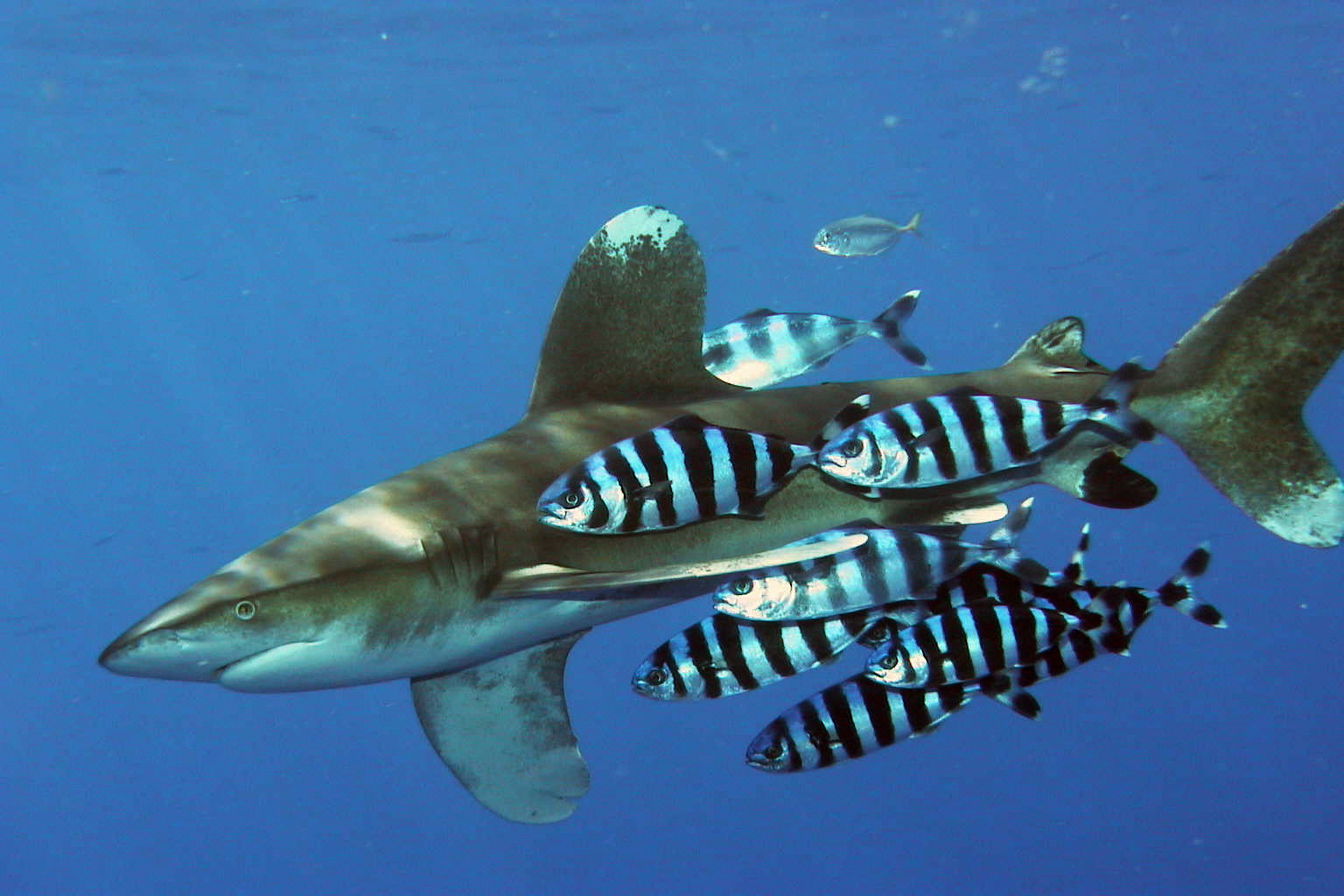
the oceanic whitetip, one of the newly protected species


This is big news in the world of sharks and rays conservation! CITES (the Convention on International Trade in Endangered Species of Wild Fauna and Flora), has announced that they have placed 5 endangered sharks and manta rays under CITES control. Under this, the oceanic whitetip (Carcharhinus longimanus), scalloped hammerhead (Sphyrma lewini), great hammerhead shark (Sphyrna mokarran), smooth hammerhead shark (Sphyrna zigaena) and the porbeagle shark (Lamna nasus), are protected, along with the manta ray (Manta birostris). From now on, all of the above species must be harvested with a CITES permit,  and evidence must be provided that they are harvested sustainably and legally.

credit to sharkangels.org


note: the oceanic white tip picture is not mine. credits to http://commons.wikimedia.org/wiki/File:Carcharhinus_longimanus_1.jpg


Wednesday, August 8, 2012

The Nurse Shark

The Nurse Shark
       Ginglymostoma cirratum


The nurse shark is a common shark species. It poses no threat to humans unless harassed or threatened.

Identification:
The nurse shark's most identifiable feature are it's conspicuous nasal barbels.
Color is variable, ranging from light yellowish to dark brown. The underside is a whitish-gray color. Neonatal nurse sharks have dark spots to aid camouflage.

 Another way to identify a nurse shark is by its caudal fin, which is almost completely an upper lobe.


Classification:
Kingdom : Animalia
Phylum : Chordata
Subphylum : Vertebrata
Class : Chondrichthyes
Subclass :  Elasmobranchii
Order : Orectolobiformes
Family : Orectolobidae
Genus : Ginglymostoma
Species : cirratum

Similar Species and Other Family Members:
There are no similar species or any other species in the family.

Reproduction:
Nurse sharks are an ovoviviparous. Male nurse sharks are sexually mature at 10 - 15 years, while females are sexually mature at 15 - 20 years. Nurse sharks give birth to 20 - 30 young about every other year. The gestation period is 5.5 months.

Size:
Males mature at 210 cm (7 feet), while females mature at 240 cm (8 feet). The maximum reported length is 430 cm (14 feet), but most experts agree that 430 cm is an exaggeration. A more realistic size estimate is 270 cm (9 feet).

Diet: 
The nurse shark feeds on crabs, lobsters, bivalves, squid, bottom-dwelling fish, octopus, shrimp, sea snails and sea urchins. They will also occasionally feed on stingrays. Most feeding is done at night, as nurse sharks often rest during the day.

Teeth & Jaws:
Here is an image of fossilized nurse shark teeth.


Habitat and Distribution:
Nurse sharks live on reefs and are found all throughout Atlantic reefs. They are found in tropical and sub-tropical waters of the east coast of the Americas and the west coast of Africa. This species is abundant all year long in Florida and the Caribbean.

Life Span:
The life span in the wild is unknown, but the oldest shark in captivity reached an age of 25 years.

Conservation Status:
According to the IUCN Red List of Threatened Species, the nurse shark is data deficient, meaning there is not enough data to determine a conservation status.

note: none of the images are mine

Monday, June 25, 2012

Shark Classification

Here is a quick thing on shark classification

Kingdom- Animalia
Phylum- Chordata
Subphylum- Vertebrata
Class- Chondrichtyes (cartilaginous fish)
Subclass- Elasmobranchii (upper jaw that is not fused to the braincase, no swim bladder, advanced electroreceptive system, a spiracle, skin with placoid scales, teeth modified placoid scales, and 5-7 separate slit-like gill openings on each side of the body: there are about 600 species of sharks, skates, and rays) 
Subclass- Plagiostomi (sharks and rays: upper jaw hung from skulls and different kind of blood)
Superorder- Selachimorpha (sharks: free upper eyelids, gill openings on the head, and pectoral fins separate from the side of the head)
Orders- Living sharks are split into 8 orders.


Shark Orders