

Friday, April 5, 2013
Another Shark Infographic...
Here is another infographic. It has some interesting facts for those of you that want to learn some more shark basics.

Thursday, March 14, 2013
CITES Protects Sharks and Manta Rays
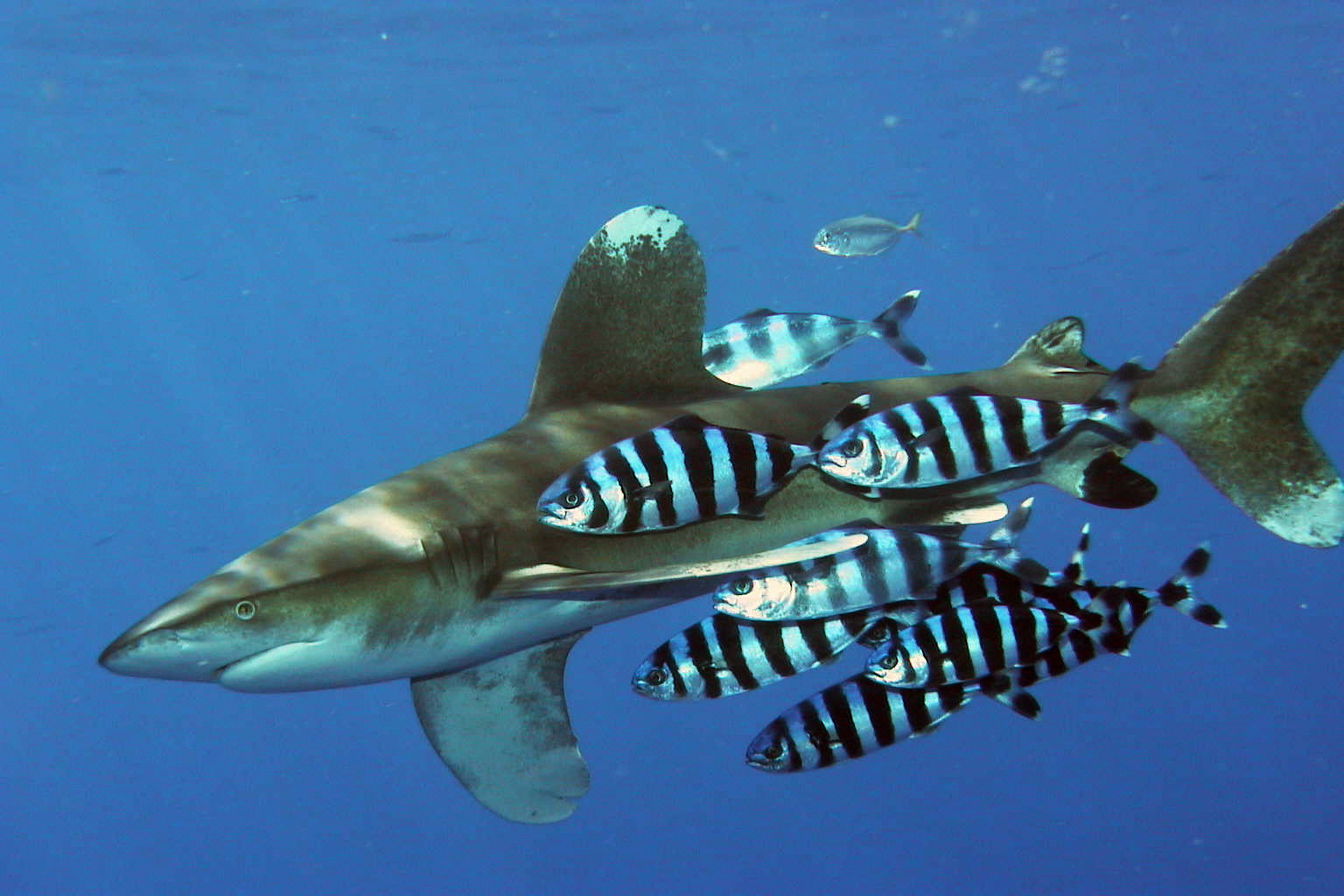 |
| the oceanic whitetip, one of the newly protected species |
This is big news in the world of sharks and rays conservation! CITES (the Convention on International Trade in Endangered Species of Wild Fauna and Flora), has announced that they have placed 5 endangered sharks and manta rays under CITES control. Under this, the oceanic whitetip (Carcharhinus longimanus), scalloped hammerhead (Sphyrma lewini), great hammerhead shark (Sphyrna mokarran), smooth hammerhead shark (Sphyrna zigaena) and the porbeagle shark (Lamna nasus), are protected, along with the manta ray (Manta birostris). From now on, all of the above species must be harvested with a CITES permit, and evidence must be provided that they are harvested sustainably and legally.
 |
| credit to sharkangels.org |

Wednesday, August 8, 2012
The Nurse Shark
The Nurse Shark
Ginglymostoma cirratum
The nurse shark is a common shark species. It poses no threat to humans unless harassed or threatened.
Identification:
The nurse shark's most identifiable feature are it's conspicuous nasal barbels.


Phylum : Chordata
Subphylum : Vertebrata
Class : Chondrichthyes
Subclass : Elasmobranchii
Order : Orectolobiformes
Family : Orectolobidae
Genus : Ginglymostoma
Species : cirratum
Similar Species and Other Family Members:
There are no similar species or any other species in the family.
Reproduction:
Nurse sharks are an ovoviviparous. Male nurse sharks are sexually mature at 10 - 15 years, while females are sexually mature at 15 - 20 years. Nurse sharks give birth to 20 - 30 young about every other year. The gestation period is 5.5 months.
Size:
Males mature at 210 cm (7 feet), while females mature at 240 cm (8 feet). The maximum reported length is 430 cm (14 feet), but most experts agree that 430 cm is an exaggeration. A more realistic size estimate is 270 cm (9 feet).
Diet:
The nurse shark feeds on crabs, lobsters, bivalves, squid, bottom-dwelling fish, octopus, shrimp, sea snails and sea urchins. They will also occasionally feed on stingrays. Most feeding is done at night, as nurse sharks often rest during the day.
Teeth & Jaws:
Here is an image of fossilized nurse shark teeth.

Habitat and Distribution:
Nurse sharks live on reefs and are found all throughout Atlantic reefs. They are found in tropical and sub-tropical waters of the east coast of the Americas and the west coast of Africa. This species is abundant all year long in Florida and the Caribbean.
Life Span:
The life span in the wild is unknown, but the oldest shark in captivity reached an age of 25 years.
Conservation Status:
According to the IUCN Red List of Threatened Species, the nurse shark is data deficient, meaning there is not enough data to determine a conservation status.
note: none of the images are mine

Ginglymostoma cirratum
The nurse shark is a common shark species. It poses no threat to humans unless harassed or threatened.
Identification:
The nurse shark's most identifiable feature are it's conspicuous nasal barbels.

Color is variable, ranging from light yellowish to dark brown. The underside is a whitish-gray color. Neonatal nurse sharks have dark spots to aid camouflage.

Another way to identify a nurse shark is by its caudal fin, which is almost completely an upper lobe.

Classification:
Kingdom : AnimaliaPhylum : Chordata
Subphylum : Vertebrata
Class : Chondrichthyes
Subclass : Elasmobranchii
Order : Orectolobiformes
Family : Orectolobidae
Genus : Ginglymostoma
Species : cirratum
Similar Species and Other Family Members:
There are no similar species or any other species in the family.
Reproduction:
Nurse sharks are an ovoviviparous. Male nurse sharks are sexually mature at 10 - 15 years, while females are sexually mature at 15 - 20 years. Nurse sharks give birth to 20 - 30 young about every other year. The gestation period is 5.5 months.
Size:
Males mature at 210 cm (7 feet), while females mature at 240 cm (8 feet). The maximum reported length is 430 cm (14 feet), but most experts agree that 430 cm is an exaggeration. A more realistic size estimate is 270 cm (9 feet).
Diet:
The nurse shark feeds on crabs, lobsters, bivalves, squid, bottom-dwelling fish, octopus, shrimp, sea snails and sea urchins. They will also occasionally feed on stingrays. Most feeding is done at night, as nurse sharks often rest during the day.
Teeth & Jaws:
Here is an image of fossilized nurse shark teeth.

Habitat and Distribution:
Nurse sharks live on reefs and are found all throughout Atlantic reefs. They are found in tropical and sub-tropical waters of the east coast of the Americas and the west coast of Africa. This species is abundant all year long in Florida and the Caribbean.
Life Span:
The life span in the wild is unknown, but the oldest shark in captivity reached an age of 25 years.
Conservation Status:
According to the IUCN Red List of Threatened Species, the nurse shark is data deficient, meaning there is not enough data to determine a conservation status.
note: none of the images are mine
Monday, June 25, 2012
Shark Classification
Here is a quick thing on shark classification
Kingdom- Animalia
Phylum- Chordata
Subphylum- Vertebrata
Class- Chondrichtyes (cartilaginous fish)
Subclass- Elasmobranchii (upper jaw that is not fused to the braincase, no swim bladder, advanced electroreceptive system, a spiracle, skin with placoid scales, teeth modified placoid scales, and 5-7 separate slit-like gill openings on each side of the body: there are about 600 species of sharks, skates, and rays)
Subclass- Plagiostomi (sharks and rays: upper jaw hung from skulls and different kind of blood)
Superorder- Selachimorpha (sharks: free upper eyelids, gill openings on the head, and pectoral fins separate from the side of the head)
Orders- Living sharks are split into 8 orders.
 |
| Shark Orders |
Friday, February 24, 2012
Who has More to Fear: Sharks or Humans?
Here is a quick graphic on the truth about the shark human relationship. You'll be surprised at the numbers.....

Photo credit: Surfmeisters.com
Photo credit: Surfmeisters.com
Monday, December 19, 2011
Zebra Shark
The Zebra Shark
Stegostoma fasciatum
 The zebra shark is know for its beautiful markings. There are no attacks on humans by a zebra shark on record.
Identification:
The easiest way to identify a zebra shark is by its unique markings. When it is young it has striped markings (hence the name zebra shark). As they get older, the stripes break into spots. Sometimes the spots will make the outline of the stripes, such as in the picture above. The coloration in juveniles is dark brown with tan or pale yellow stripes. Adult coloration is tan to pale yellow with black to dark brown spots. The zebra shark has 5 gills on each side. It has a broad elongated upper lobe of the caudal fin, and almost no lower lobe. It has small eyes and a small mouth with barbels on both sides of its mouth.
Classification:
Kingdom: Animalia
Phylum: Chordata
Subphylum: Vertebrata
Class: Chondrichtyes
Subclass: Elasmobranchii
Order: Orectolobiformes
Family: Stegostomatidae
Genus: Stegostoma
Species: fasciatum
Similar Species and Other Family Members:
The zebra shark is the sole member of the Stegostomatidae family. This shark is very distinctive, but as it is sometimes called a leopard shark, it is often confused with a cold water species which is also called the leopard shark (Triakis semifasciata).
Reproduction:
The zebra shark is oviparous (lays eggs). They will lay one to four eggs a brood. Their size at birth is around 25 centimeters (9.8 inches).
Size:
The maximum length of the zebra shark is 350 cm (11.5 feet).
Diet:
The zebra shark feeds on shellfish, crustaceans, and small fishes.
Teeth:
Habitat and Distribution:
The zebra shark lives in the warm waters of the tropical western Pacific and Indian Ocean.
Life Span:
The zebra shark's life span is believed to reach up to 30 years in the wild. The longest known life span in captivity is 25 years.
Conservation Status:
The zebra shark is listed as vulnerable.
A video of a zebra shark I took at
Discovery Cove.
Note: I do not own any of the still images.
Stegostoma fasciatum
 The zebra shark is know for its beautiful markings. There are no attacks on humans by a zebra shark on record.
Identification:
The easiest way to identify a zebra shark is by its unique markings. When it is young it has striped markings (hence the name zebra shark). As they get older, the stripes break into spots. Sometimes the spots will make the outline of the stripes, such as in the picture above. The coloration in juveniles is dark brown with tan or pale yellow stripes. Adult coloration is tan to pale yellow with black to dark brown spots. The zebra shark has 5 gills on each side. It has a broad elongated upper lobe of the caudal fin, and almost no lower lobe. It has small eyes and a small mouth with barbels on both sides of its mouth.
Classification:
Kingdom: Animalia
Phylum: Chordata
Subphylum: Vertebrata
Class: Chondrichtyes
Subclass: Elasmobranchii
Order: Orectolobiformes
Family: Stegostomatidae
Genus: Stegostoma
Species: fasciatum
Similar Species and Other Family Members:
The zebra shark is the sole member of the Stegostomatidae family. This shark is very distinctive, but as it is sometimes called a leopard shark, it is often confused with a cold water species which is also called the leopard shark (Triakis semifasciata).
Reproduction:
The zebra shark is oviparous (lays eggs). They will lay one to four eggs a brood. Their size at birth is around 25 centimeters (9.8 inches).
 |
| A young zebra shark |
The maximum length of the zebra shark is 350 cm (11.5 feet).
Diet:
The zebra shark feeds on shellfish, crustaceans, and small fishes.
Teeth:
 |
| Zebra shark jaws |
The zebra shark lives in the warm waters of the tropical western Pacific and Indian Ocean.
Life Span:
The zebra shark's life span is believed to reach up to 30 years in the wild. The longest known life span in captivity is 25 years.
Conservation Status:
The zebra shark is listed as vulnerable.
A video of a zebra shark I took at
Discovery Cove.
Note: I do not own any of the still images.
Friday, December 9, 2011
The Whale Shark
 |
| Whale shark (Rhincodon typus) with a diver |
Identification:
The easiest way to identify a whale shark is by its massive size. It is the largest fish in the ocean. It has dark greenish to brownish gray skin covered with white or yellowish spots and irregular dark and light bars. It has a huge mouth that can reach 4 feet (1.4 meters) wide. The mouth is in front of the head, instead of below the head like it is in most sharks. It has 5 gills and small eyes.
Classification:
Kingdom: Animalia
Phylum: Chordata
Subphylum: Vertebrata
Class: Chondrichtyes
Subclass: Elasmobranchii
Order: Orectolobiformes
Family: Rhincodontidae
Genus: Rhincodon
Species: typus
Similar Species and Other Family Members:
The whale shark is the only member of the family Rhincodontidae. Its massive size and striking markings make it easy to distinguish from other sharks.
Reproduction:
The whale shark is ovoviviparous (the eggs are nourished by a yolk, but the mother keeps them inside her body until they run out of food from the yolk and then they are born live). Their size at birth is 21 to 25 inches (55 to 64 centimeters). Whale sharks are sexually mature at 30 years. It is thought that one brood can contain up to 300 young!
 |
| A man holding a young whale shark. |
The whale shark can reach lengths of up to 45 feet ( 13.7 meters)! It can weigh up to 30 tons (33 metric tons).
Diet:
The whale shark lives mainly on plankton, but will also eat small squids and bony fishes.
Teeth:
Here is a good image of whale shark teeth.

Habitat and Distribution:
Whale sharks are found in warm waters all around the world. They are not, however, found in the Mediterranean Sea. Large populations of whale sharks are often found near Ningaloo Reef, Australia.
Life Span:
The whale shark may live up to 150 years.
Conservation Status:
The whale shark is now listed as a threatened species.
note: I do not own any of these pictures
Subscribe to:
Posts (Atom)